Skip to content
TASCHENWERK

Workshop

Six steps, and where each one fails

Nothing here is a secret technique. Leatherwork has been the same handful of operations for two centuries. What separates an article that lasts a decade from one that lasts eighteen months is whether each of them was done properly or skipped to save four minutes.

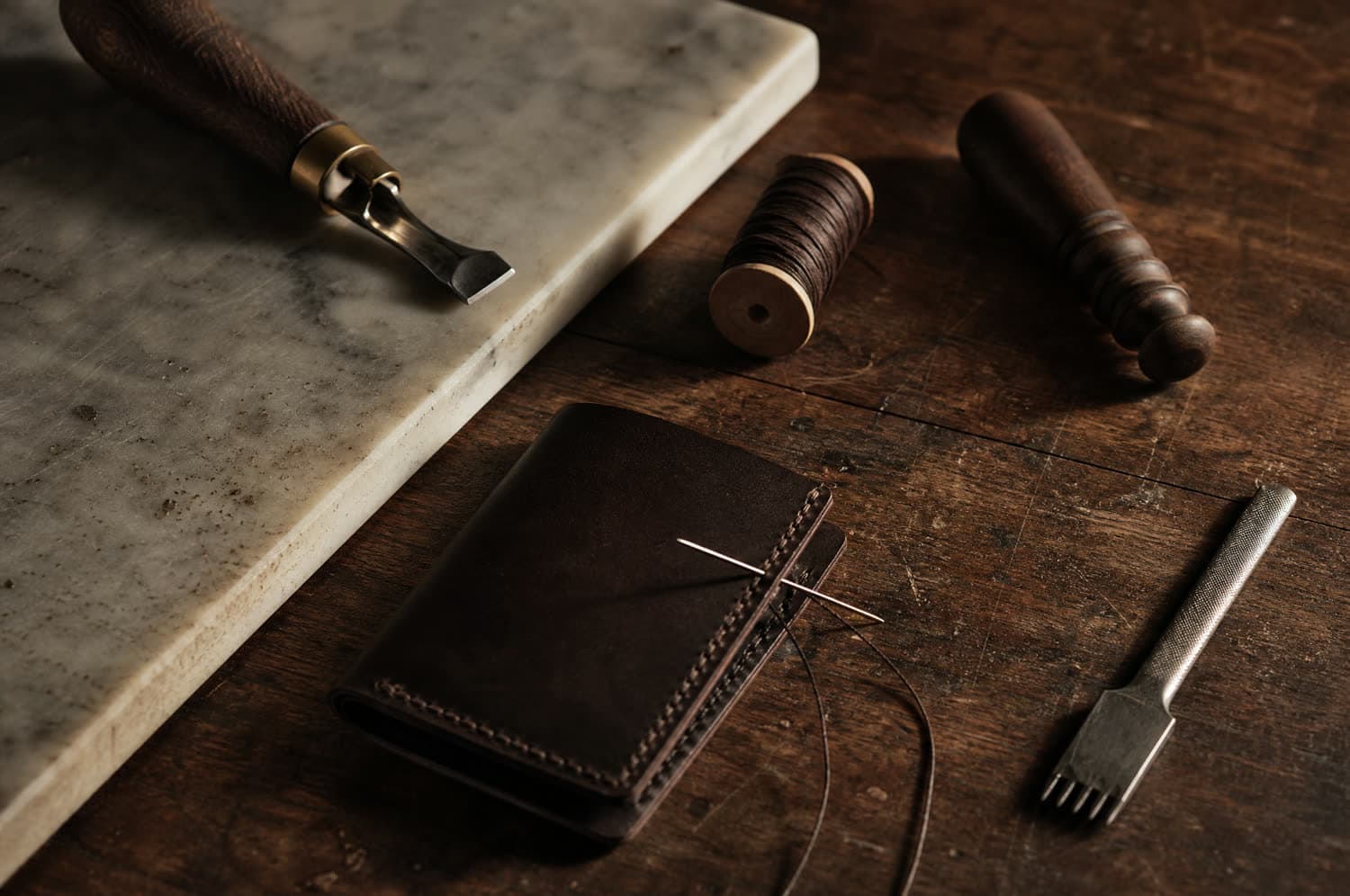
A leather workshop bench from above with a marble slab, edge beveller, wooden slicker, waxed thread and a half-stitched wallet with two needles still in the seam
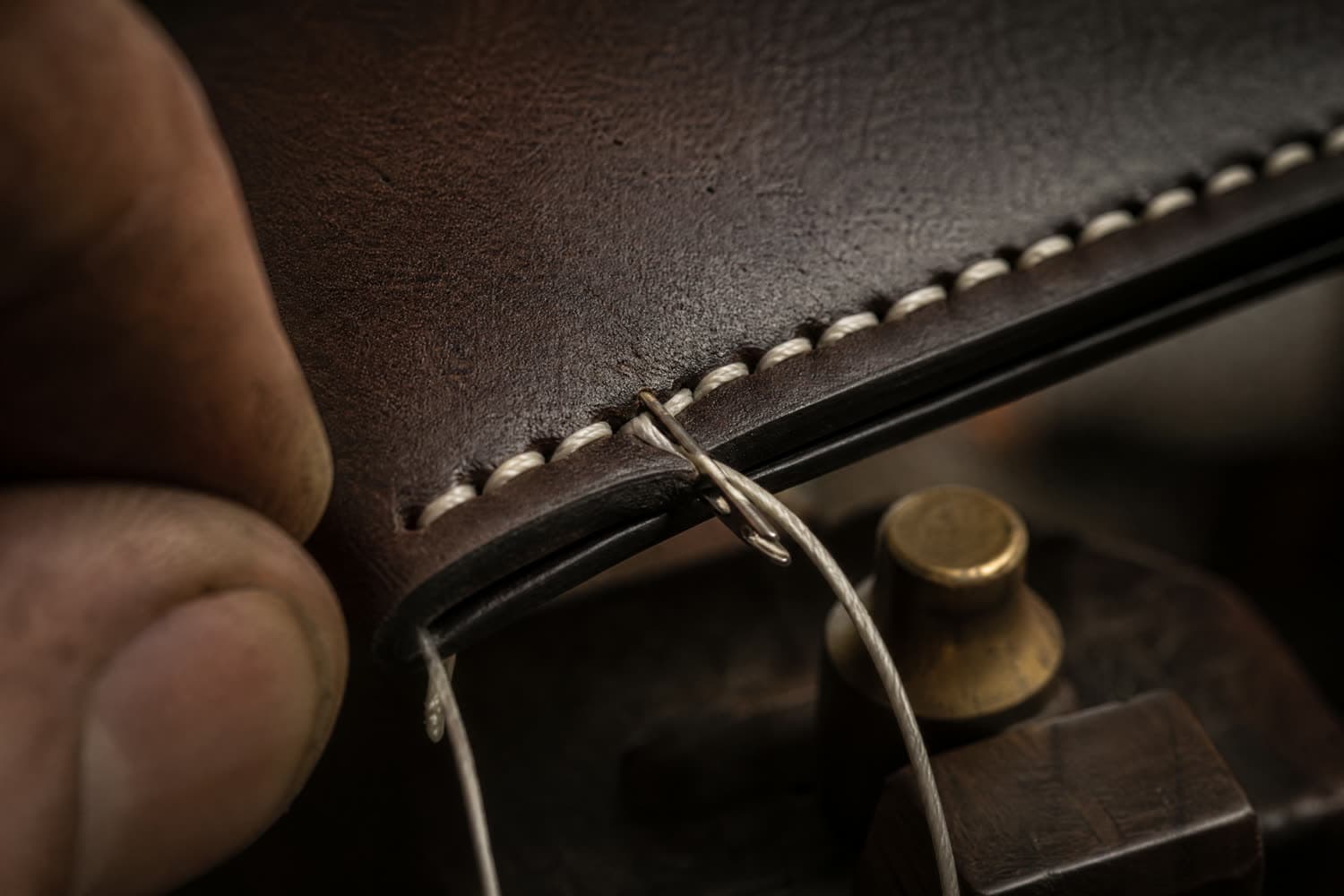
Macro of hand saddle stitching along a burnished wallet edge, thread visibly crossing within each hole

The process

01

Selecting

A hide is not uniform. The back and rump are dense and consistent; the belly is stretchy and the neck is full of growth wrinkles. Wallet panels and belt straps come from the back. The belly gets used for linings and small parts, or not at all. This single decision does more for how an article lasts than anything that follows it.

02

Cutting

Panels are clicked out with steel rule dies for repeatability, aligned to the direction the hide stretches so a belt does not lengthen unevenly. Off-cuts above a certain size go back into the small-parts bin; below it, into the fibre stream.

03

Skiving

Where two or three layers meet — a wallet spine, a folded key case — the leather is bevelled down so the joint stays flat. Skipping this is why a cheap wallet is fat at the fold and thin everywhere else.

04

Stitching

Holes are marked with a pricking iron at five to the centimetre, then saddle-stitched: two needles, one thread, crossing inside every hole. The distinction matters — a machine lockstitch runs away from a single break, a saddle stitch does not, which is why one broken loop is a repair rather than a failure.

05

Edging

Cut edges are bevelled, sanded through three grits, damped and burnished with a wooden slicker until the fibres lie down and gloss over. A burnished edge sheds water and grit. A raw one wicks both straight into the core of the leather.

06

Finishing

A first coat of balm, a check against the specification — thickness, slot count, dimensions, weight — and the reference number goes on the packaging. The figures we publish are measured on the finished article, not taken from the pattern.

Who Taschenwerk is

Taschenwerk is the shop name of HGL Lederwaren GmbH, a limited company registered and trading in Weinsheim, Germany. The name is plain German: Tasche, a pocket or a bag, and -werk, a works or a workshop.

We make one narrow category of thing — articles small enough to live in a pocket — and we make 41 of them. There is no handbag line, no luggage, no seasonal collection. That limit is deliberate: a range this size can be specified honestly, article by article, and a person can hold the whole of it in their head when you write in with a question.

All our patterns are our own or are generic forms in long use. We do not copy another maker’s hardware, we do not reproduce anybody’s monogram or pattern, and nothing we sell carries a logo — including ours. A wallet does not need a brand stamped on the outside of it.

A leather patch embossed with a brass T standing on a row of saddle stitches, resting on a workbench beside an awl and a bobbin of waxed thread

The mark: a T standing on a run of saddle stitches. It goes on the box, not on the article.

Company
HGL Lederwaren GmbH
Trading as
Taschenwerk
Based in
Weinsheim, Germany
Range
41 articles, pocket carry only
Leather
Bovine hide, a by-product of the food industry

Registered company details are in the Impressum, as German law requires.
Changed your mind about an order? You have 14 days to withdraw, without giving a reason.

Vertrag widerrufen — withdraw from contract