Material
How to read a hide
“Genuine leather” is not a grade. It is a legal floor, and it covers the best hide in the tannery and the worst offcut equally well. Here is what the words underneath it actually mean, so you can judge any leather article — ours or anyone else’s — by looking at it.
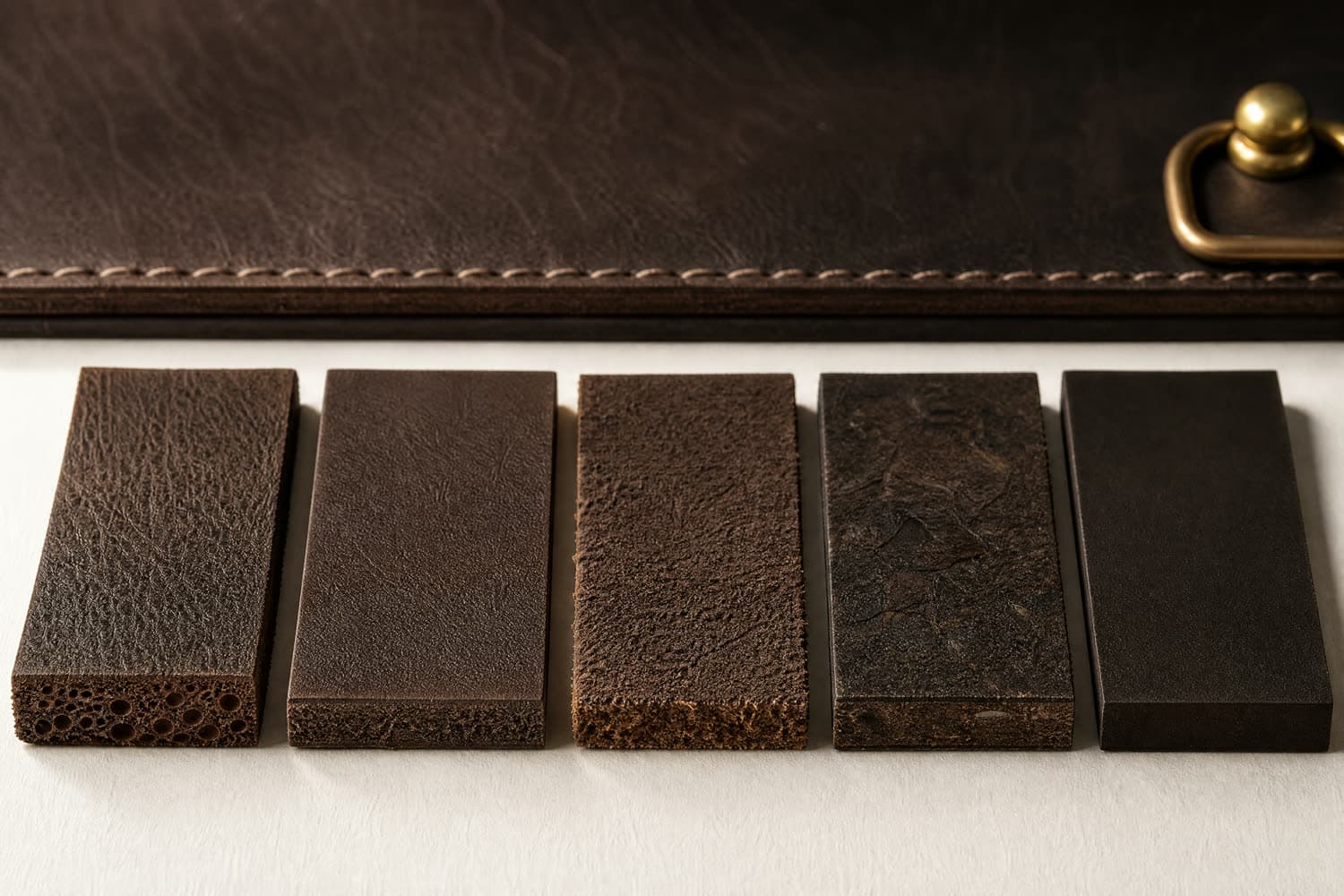
Left to right: full-grain, top-grain, split, bonded, coated synthetic. The difference is clearest at the cut edge, which is why we burnish ours rather than cover them.
The five terms, in order of what they cost
01
Vollnarbenleder
Full-grain
- What it is
- The outermost layer of the hide with the grain surface left intact — nothing sanded off, nothing sprayed on to hide it.
- Why it matters
- The grain layer is where the fibres are densest and most tangled, which is where the strength is. It is also the only layer that burnishes and darkens into a patina rather than simply wearing through.
- How to spot it
- Look at raking light: you will see pores, the odd healed scar, and slight variation across the panel. A surface with no variation at all has been corrected.
- The trade-off
- Costs more, arrives stiffer, and shows every mark you give it. Some people want exactly that; some do not.
02
Narbenleder / korrigiertes Narbenleder
Top-grain
- What it is
- The same upper layer, but lightly sanded to remove blemishes and finished with a thin pigment or coating.
- Why it matters
- You get an even colour and a consistent surface across a whole run, and better resistance to staining. Black stays black for years.
- How to spot it
- Very uniform surface, sometimes with a faint printed grain pattern that repeats. The cut edge still shows a dense fibre structure.
- The trade-off
- Slightly less strong than full-grain because material was removed, and it will not develop a real patina — the finish sits on top.
- What it is
- The lower layer left after the grain layer is split away. Usually pigmented or embossed on the surface to imitate a grain.
- Why it matters
- It is genuine leather, it is considerably cheaper, and for a part that spends its life being abraded rather than admired it is often the sensible choice.
- How to spot it
- The cut edge is fibrous and suede-like all the way through. The surface, if embossed, has a regularity that a real grain never has.
- The trade-off
- Weaker, and the applied finish can crack or peel with heavy flexing. Never develops a patina.
04
Rekonstituiertes Leder / Lederfaserstoff
Bonded
- What it is
- Leather fibre offcuts, ground up and bonded with polyurethane onto a backing. Legally leather in only a narrow sense, and in Germany it must be labelled as such.
- Why it matters
- It is the cheapest way to make something look like leather while still being able to use the word.
- How to spot it
- The cut edge shows a uniform compressed sheet with a visible backing layer, not a fibre structure.
- The trade-off
- It delaminates. We do not sell it, in any article, in any component.
05
Kunstleder / PU
Coated synthetic
- What it is
- A polymer coating on a textile backing. No animal hide involved at all.
- Why it matters
- Waterproof, uniform, cheap, and vegan — a real advantage for some buyers.
- How to spot it
- Perfectly regular surface, no pores, and the cut edge is fabric.
- The trade-off
- The coating eventually cracks and there is nothing underneath to save it. We do not sell it, and we would not call it leather if we did.
Vegetable or chrome
Tanning is what stops a hide rotting. There are two methods in common use and they produce genuinely different materials — not a better one and a worse one.
Pflanzlich gegerbt — vegetable
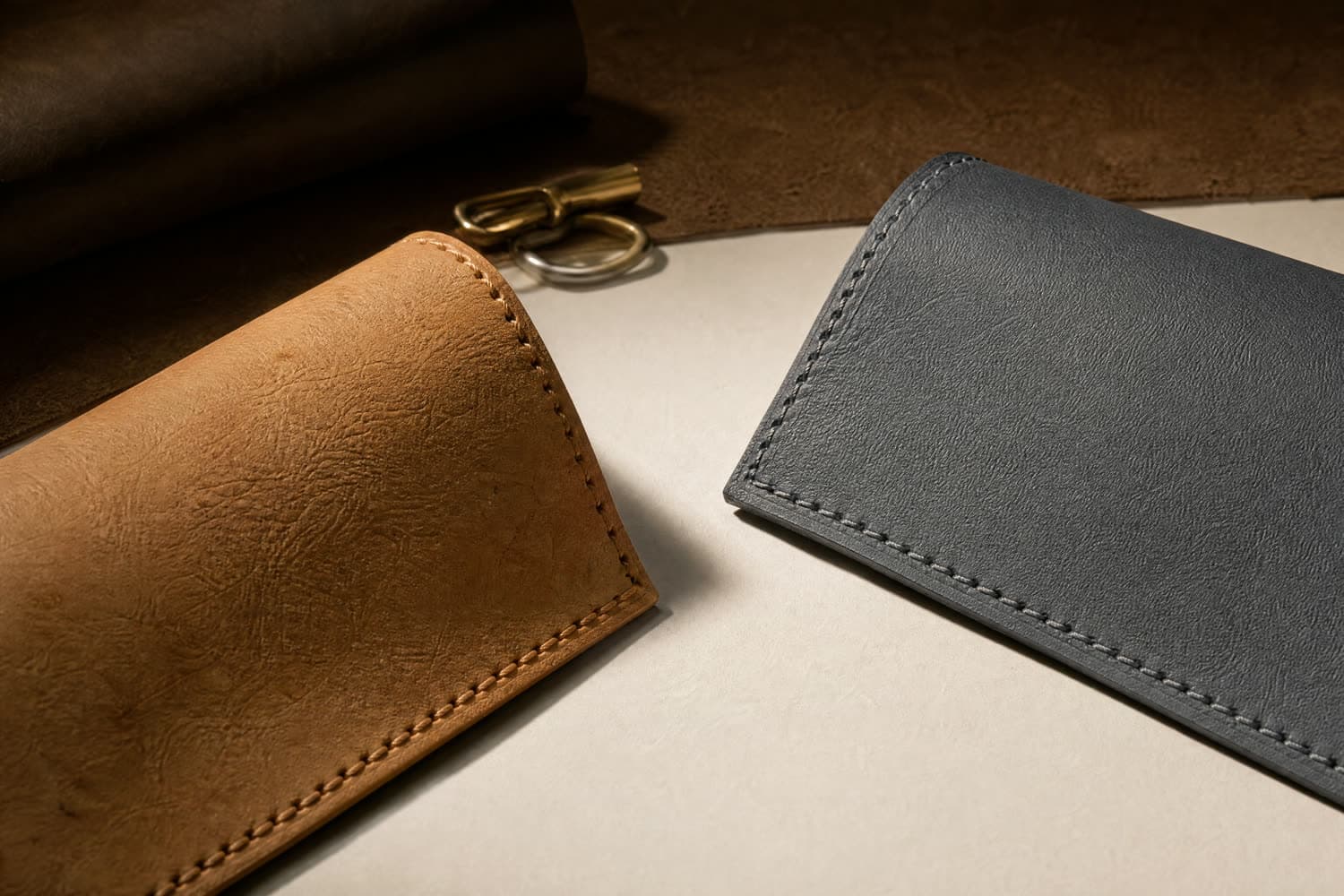
Tannins from tree bark, over weeks in a pit. Produces a firm, dense leather that holds a moulded shape, burnishes at the edges and darkens dramatically with light and handling. It is what a patina is made of. It marks easily, dislikes prolonged soaking, and takes a season to break in.
Chromgegerbt — chrome
Chromium salts, over about a day in a drum. Produces a softer, more supple leather with far better colour stability and water resistance. It does not develop a patina; it stays close to how it arrived. For a black wallet or anything living against coins, that is usually what you want.
Chrome tanning is sometimes presented as inherently unsafe. The regulated risk is chromium VI, which is a by-product of poor process control, not an ingredient. EU law caps it at 3 mg/kg for leather in skin contact and our tanneries certify compliance — the details are here.
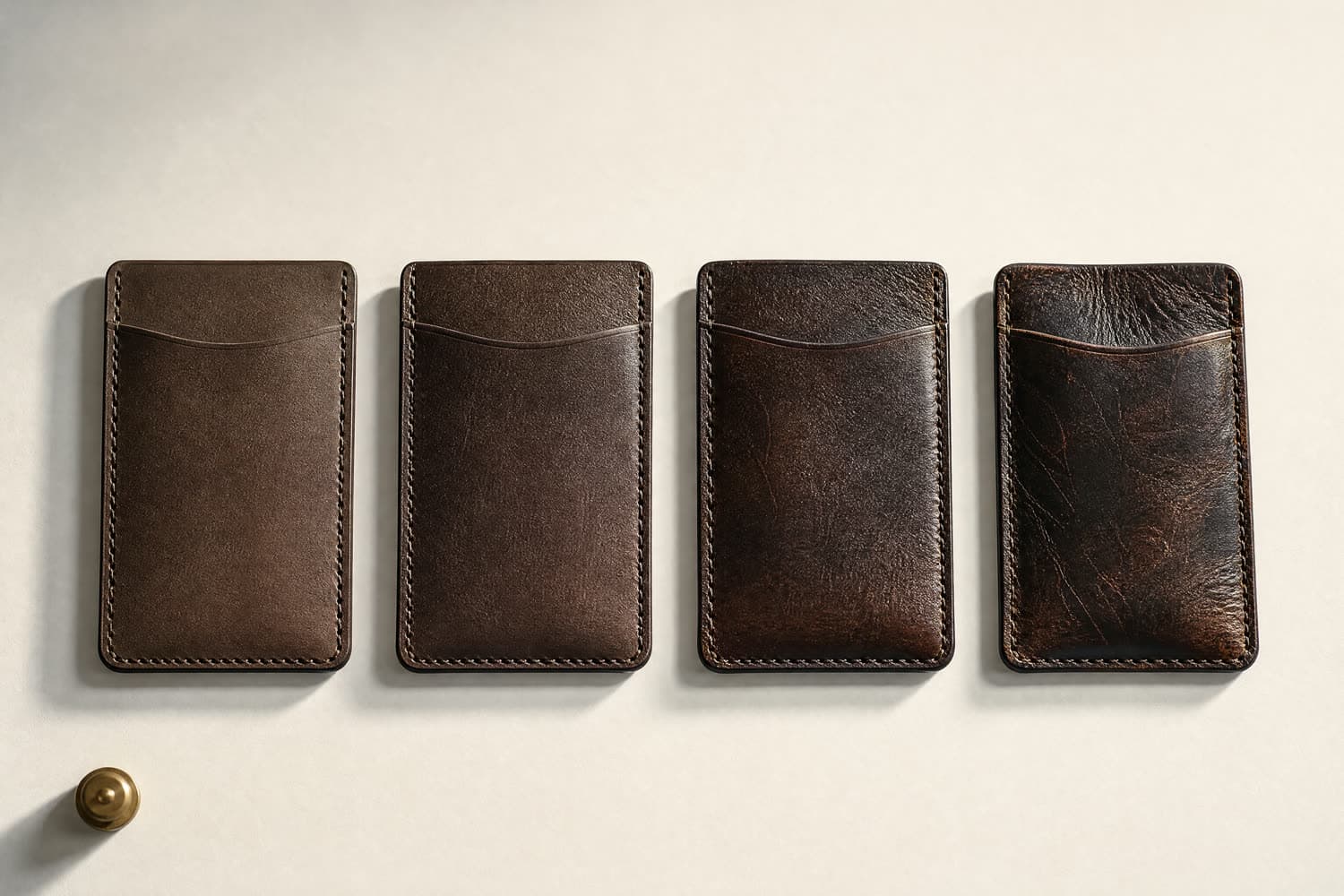
The same vegetable-tanned card holder at roughly nought, six, eighteen and thirty-six months of daily use. Nothing was done to them except carrying them and balming twice a year.
What that adds up to across our range
We publish this breakdown because a range that claims to be entirely full-grain is usually either expensive beyond reason or not telling the truth.
- Full-grain
- 30
- Everything where the leather is doing structural work or is meant to age.
- Top-grain
- 07
- Where colour stability matters more than patina — coin bays, zip wallets, black dress articles.
- Split
- 02
- Two bag items: the pen sleeves and the cable roll. Declared on both.
- No leather
- 02
- The buckle set and the care balm. Neither contains leather.
Describing split leather as full-grain would be a misleading commercial practice under the UWG, and beyond that it is simply a lie about what you are buying with 69,00 € of your money. The grade column in the ledger is sortable for exactly this reason.